Inventory & Warehouse
Build a Cycle Count App with Glide
A Cycle Count app built on Glide replaces disruptive wall-to-wall inventory counts with a continuous counting program — verifying a portion of your inventory every day so accuracy improves steadily without shutting down operations. GlideApps Agency builds cycle count systems that integrate seamlessly with your existing inventory data and give managers real-time visibility into count accuracy across every location.
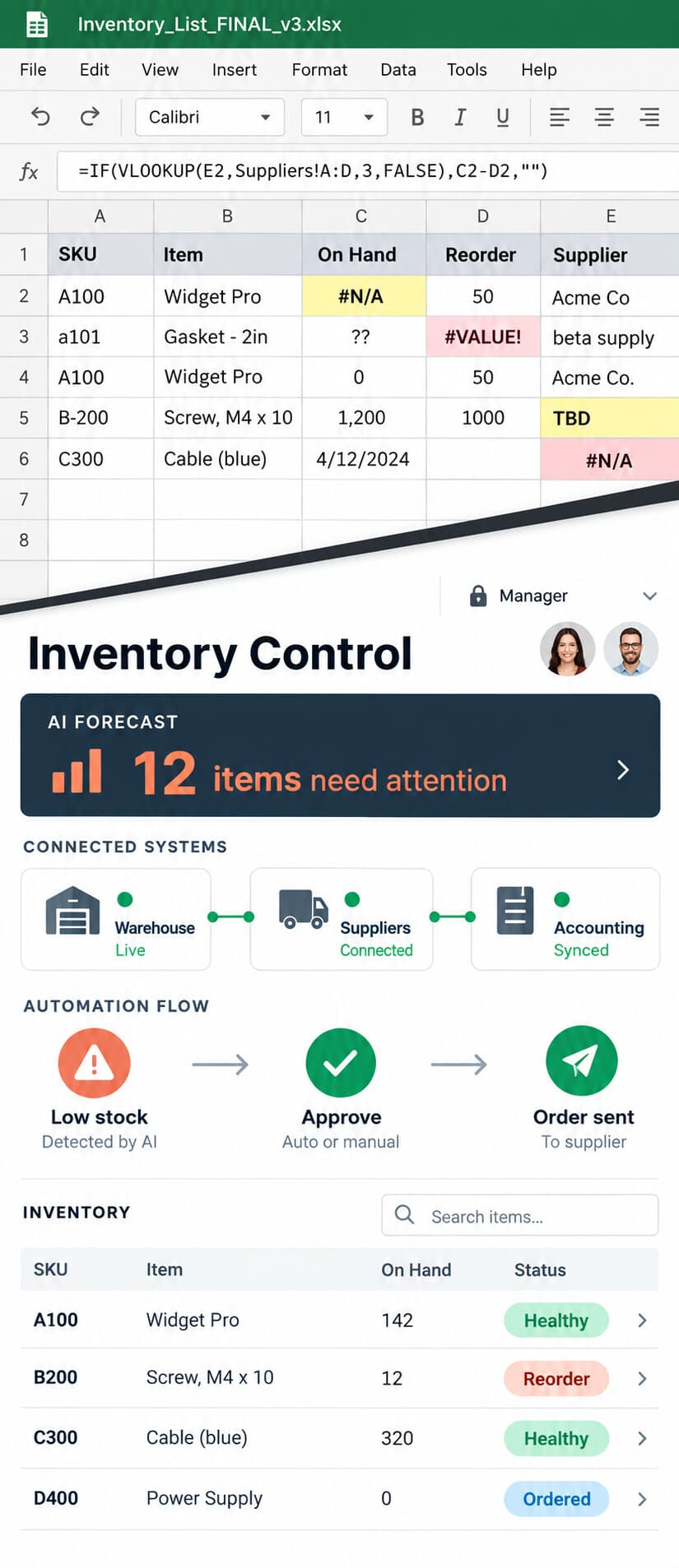
GlideApps Agency builds production-ready Cycle Count apps for enterprises and growth-stage companies — 350+ Glide apps delivered since 2019, with deep expertise in inventory & warehouse. Projects start at $15,000 with typical delivery in 4–8 weeks.
What does building a Cycle Count app include?
Every engagement includes discovery, data architecture, UI/UX design, development, QA, and post-launch support — not just a build-and-handoff.
Discovery & Architecture
Requirements mapping, data modeling, integration planning, and platform-fit assessment before a single screen is built.
UI/UX Design
Wireframes and interactive prototypes designed for your users — not generic templates. Optimized for mobile and desktop.
Development & QA
Built by certified Glide experts with enterprise experience. Rigorous testing across devices, roles, and data volumes.
Launch & Support
User training, documentation, and ongoing maintenance. We don't disappear after deployment.
Key features of your Cycle Count app
Automated Count Schedule Generation
The app generates daily count assignments based on ABC classification, count frequency rules, and location rotation — ensuring high-value items are counted more often and every location gets covered.
Mobile Count Interface
Counters receive their daily assignment on their phone, navigate to each location, scan the item or bin label, enter the physical count, and submit — all in a streamlined mobile workflow.
Variance Escalation
Counts with variances above a configurable threshold are automatically escalated for recount or investigation. Clean counts update the last-counted date and reset the item's count schedule.
Accuracy Trend Dashboard
Track inventory accuracy over time by location, category, and value tier to measure the effectiveness of your cycle count program and identify areas that need more frequent counting.
Who uses a Cycle Count app?
How much does a Cycle Count app cost?
Projects start at $15,000 for internal business apps. Most clients invest $40,000–$80,000 annually across development, iteration, and support.
| Project Type | Timeline | Starting At |
|---|---|---|
| Internal Business App | 4–6 weeks | $15,000 |
| Client-Facing Portal | 4–6 weeks | $20,000 |
| Enterprise Platform | 6–8 weeks | $40,000 |
| Multi-App Architecture | 8–12 weeks | $50,000+ |
The Glide Sprint Process
How we build your Cycle Count app
Discovery
Requirements, data modeling, and platform-fit assessment. We define scope before writing a line of logic.
Architecture
Data structure, security model, integration map, and user roles. The blueprint that prevents rework.
Build
Iterative development with weekly demos. You see progress, not just status updates.
QA & Launch
Cross-device testing, user acceptance, and production deployment with rollback safety.
Support
Ongoing maintenance, feature iterations, and scaling support. We don't disappear after launch.
Frequently asked questions about Cycle Count apps
How many items should we count per day?+
Can cycle counts run during normal business hours?+
How does the app select which items to count each day?+
What happens when a cycle count reveals a large variance?+
Can we track cycle count accuracy as a KPI?+
Related apps you might need
Inventory Management App
Inventory & Warehouse
Stock Management App
Inventory & Warehouse
Warehouse Management App
Inventory & Warehouse
Inventory Tracking App
Inventory & Warehouse
Barcode Inventory App
Inventory & Warehouse
Explore all our Inventory & Warehouse apps built with Glide.
“They've been professional throughout the development and delivered great results in an incredible turnaround time.”
Matt Wilson — VP, Insurance Brokerage
Ready to build your Cycle Count app?
Schedule a consultation with our Senior Partners. We'll scope your project, recommend the right approach, and deliver in 4–8 weeks.